

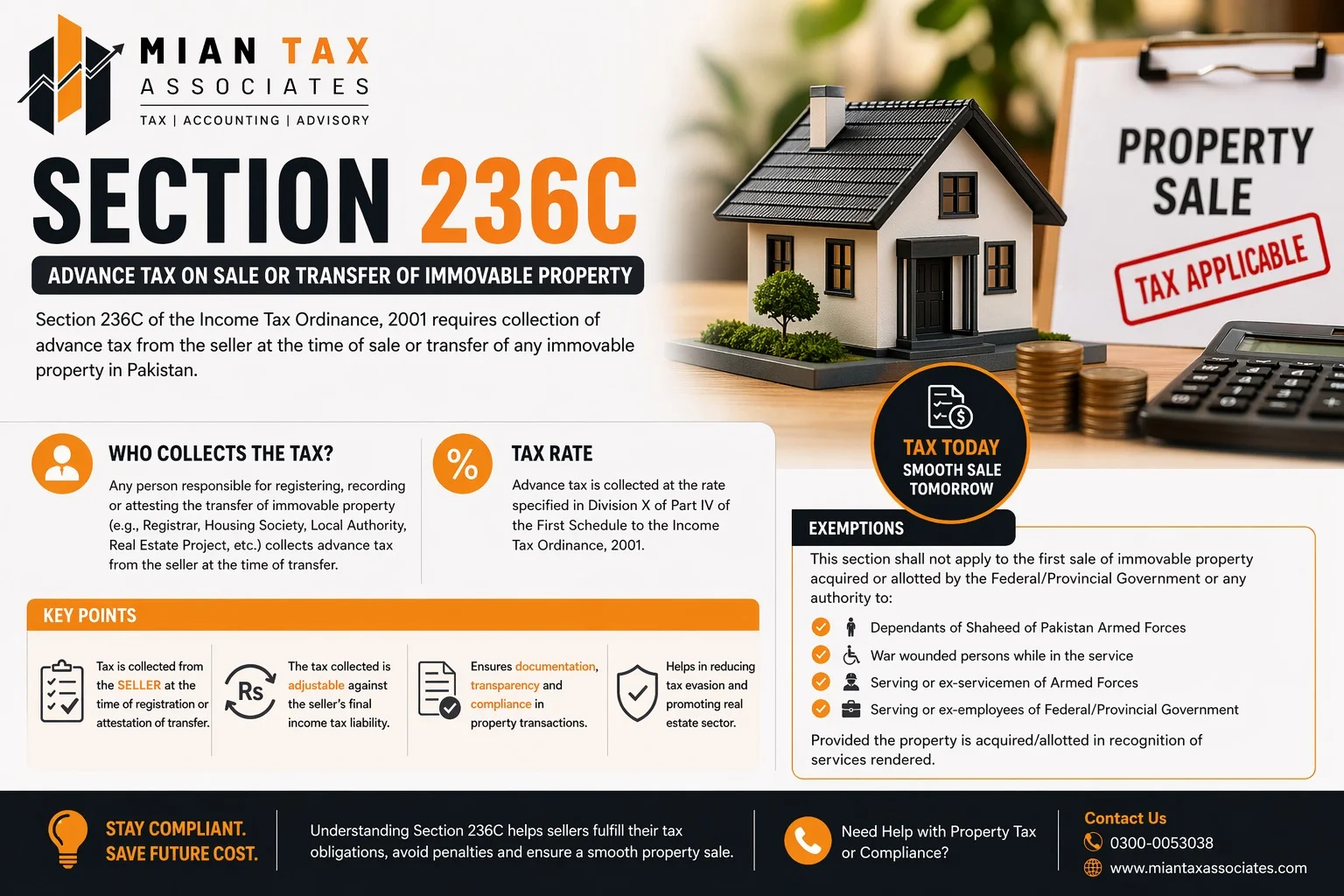
Section 236C of the Income Tax Ordinance, 2001 is a key provision governing the collection of advance tax on the sale or transfer of immovable property in Pakistan. This section plays a crucial role in ensuring tax compliance and documentation within the real estate sector.
Whether you are selling a residential house, commercial property, or plot, understanding how Section 236C works can help you avoid unnecessary deductions and manage your transaction more efficiently.
What is Section 236C?
Section 236C deals with the collection of advance tax from the seller (transferor) at the time of property transfer.
Under this provision:
- Advance tax is collected at the time of sale or transfer
- The responsibility lies with the registering authority
- The tax is deposited with the Federal Board of Revenue (FBR)
This ensures that property transactions are properly documented and reported within the tax system.
Who Collects Tax Under Section 236C?
The tax is not directly paid by the seller to FBR. Instead, it is collected by the authority responsible for handling the transaction.
These include:
- Property registrars
- Housing societies
- Development authorities
- Any authority responsible for recording or attesting transfer
These entities act as withholding agents and are legally required to collect advance tax before completing the transaction.
Applicability of Section 236C
Section 236C applies to a wide range of property transactions across Pakistan.
Covered Transactions:
- Sale of residential houses
- Transfer of commercial properties
- Sale of plots (open or constructed)
- Transactions through housing societies and developers
The law applies regardless of whether the transaction is conducted privately or through an organized real estate project.
Tax Rates Under Section 236C
The advance tax rates under Section 236C are specified in the First Schedule of the Income Tax Ordinance.
Key Factors Affecting Tax Rate:
- Filer vs non-filer status
- Property value
- Government-notified rates
Generally:
- Filers pay a lower rate
- Non-filers are subject to significantly higher rates
This structure encourages taxpayers to become active filers and maintain proper tax records.
Nature of Tax – Adjustable or Final?
One of the most important aspects of Section 236C is that the tax collected is:
Adjustable Tax
This means:
- It is not a final tax liability
- It can be adjusted against your annual income tax
- Any excess amount can be claimed as a refund
However, refund processing can take time, which is why many taxpayers look for exemptions where applicable.
Exemptions Under Section 236C
The law provides certain exemptions where advance tax is not applicable.
1. Government-Allotted Properties (First Sale)
Advance tax is not applicable on:
- The first sale of property allotted by the government
- Provided it was granted in recognition of services
Eligible Beneficiaries:
- Families of martyrs (Shaheed)
- Armed forces personnel
- Government employees
- War-wounded individuals
This exemption acknowledges the contributions of these individuals and provides financial relief.
Importance of Section 236C for Property Sellers
Understanding Section 236C is essential for anyone involved in property transactions.
1. Avoid Unexpected Deductions
Many sellers are unaware of this tax and are surprised at the time of sale. Knowing about it in advance helps in better financial planning.
2. Improve Transaction Planning
By understanding tax implications, sellers can:
- Plan pricing strategies
- Adjust financial expectations
- Consider exemptions if eligible
3. Ensure FBR Compliance
Compliance with Section 236C ensures:
- Proper documentation
- Avoidance of legal issues
- Smooth transaction processing
Common Issues Faced by Sellers
Despite its importance, many sellers face challenges related to Section 236C.
Delayed Refunds
Since the tax is adjustable, refunds may take several months to process.
Incorrect Tax Deduction
Errors in filer status or property valuation can lead to excessive deductions.
Lack of Awareness
Many taxpayers are unaware of exemptions such as Section 159(1B), which can help avoid this tax altogether.
Practical Example
Consider a seller transferring a residential property.
- The registrar deducts advance tax under Section 236C
- The amount is deposited with FBR
- The seller later adjusts this tax in their annual return
If the seller qualifies for exemption (e.g., under Section 159(1B)):
- They can obtain an exemption certificate
- No tax will be deducted at the time of sale
Relationship Between Section 236C and Section 159(1B)
Section 236C and Section 159(1B) are closely connected.
- Section 236C imposes advance tax
- Section 159(1B) allows exemption from this tax
If eligible, a taxpayer can apply for an exemption certificate under Section 159(1B) to avoid deduction under Section 236C entirely.
Final Thoughts
Section 236C is a fundamental part of Pakistan’s property taxation framework. It ensures transparency, documentation, and tax compliance in real estate transactions.
However, while the tax is adjustable, it can still impact cash flow at the time of sale. Therefore, property sellers should:
- Understand applicable tax rates
- Verify their filer status
- Explore available exemptions
- Maintain proper documentation
By doing so, they can ensure a smooth, compliant, and financially efficient property transaction.